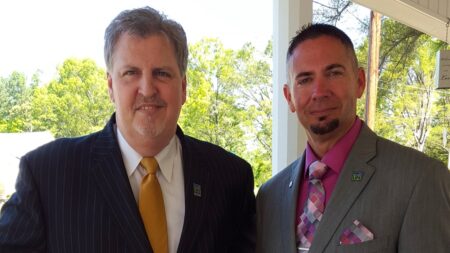



A man in New York inherited a “Yosegaki Hinomaru” banner, also known as a good luck flag, from his grandfather — who served the United States during World War II. Scott Stein shared with Fox News Digital in an email that he had initially planned on restoring the souvenir flag, but after consulting with an expert, he decided to return the flag to its rightful owner. His grandfather, Bernard Stein, served in World War II between 1942 and 1945. He underwent training at the U.S. Army boot camp at Camp Croft, South Carolina, and later served in the Philippines with the U.S. Army’s 38th Infantry Division, known as the Avengers of Bataan.
“This flag hung proudly in my grandfather’s house for many years, and I was always fascinated by it as a child,” Stein said. Like many veterans, his grandfather did not openly discuss the war or his wartime experiences. As a lifelong collector with a deep appreciation for history, Stein had begun the process of restoring the flag when the expert suggested he return it in 2017, after hearing news of a similar flag being repatriated to Japan. After conducting research, Stein discovered the Obon Society in Oregon, a nonprofit organization that facilitates the return of “non-biological human remains” such as flags that were taken during times of war.
During World War II, many Japanese soldiers carried flags inscribed with names and messages from loved ones for good luck, as noted by Stars and Stripes. Stein shared, “After initial contact and correspondence with the Obon Society and learning of their mission to locate the relatives and family of the original owners, I prepared the flag to be shipped to them for an eventual return trip to Japan.” After a seven-year search, the Obon Society was able to connect the flag to a soldier named Yukikazu Hiyama, who had died in 1945. The flag was returned to the fallen soldier’s son, who hosted a ceremony with his entire family.
During the ceremony, the man carried a portrait of his father and mother, explaining how his mother had waited her entire life for her husband to return home. Sadly, she passed away without ever seeing him again. A representative from the Obon Society shared via email with Fox News Digital, “After receiving the Yosegaki Hinomaru flag, the son carried it to the cemetery to unfurl in front of his mother’s grave — to ‘show’ her that her husband had finally returned home.” These flags are considered “non-biological human remains” as they provide closure and intense emotions for Japanese families, similar to how the return of bones and teeth brings closure to American MIA families.
According to Stars and Stripes, this flag is the only keepsake the son has of his father. The emotional ceremony and the return of the flag provided a sense of closure and peace to the family, honoring the memory of Yukikazu Hiyama. Through the efforts of the Obon Society and Scott Stein’s decision to return the flag, a piece of history was able to find its way back to the family of its rightful owner. This story serves as a reminder of the impact of war on families on both sides of the conflict, and the importance of reconciliation and remembrance in the aftermath of such events.