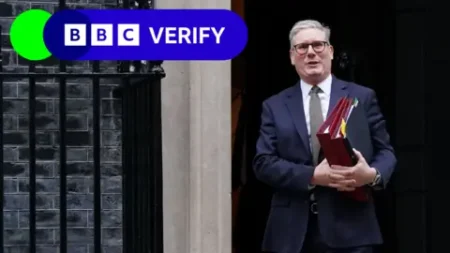




In a pivotal announcement on the global stage, Prime Minister Sir Keir Starmer has outlined ambitious climate change targets aimed at positioning the United Kingdom as a leader in emission reduction efforts. Addressing the United Nations conference of parties (COP29) in Baku, Azerbaijan, Starmer revealed that the UK aims to achieve an 81% cut in greenhouse gas emissions by the year 2035. This new target raises the bar from the previous pledge of a 78% reduction set by the preceding Conservative government and goes beyond another commitment of a 68% reduction by 2030.
The Prime Minister emphasized that the target is critical for the UK’s future energy security and economic prosperity. He sought to reassure the public that the government would not dictate individual lifestyles, stating, “It’s not about telling people how to live their lives—I’m not interested in that.” Instead, he framed the new emission reduction goal as essential for establishing energy independence and ensuring stable energy bills for consumers.
This new target builds upon recommendations from the UK’s independent Climate Change Committee (CCC), which is designed to limit global warming to 1.5 degrees Celsius in relation to 1990 levels. Notably, Sir Keir was among only seven G20 leaders present at the summit, while notable absentees included leaders from major economies such as the United States, China, France, and Germany. He refrained from commenting directly on the president-elect, Donald Trump, highlighting that the U.S. plans to rollback climate regulations announced during his campaign.
Starmer asserted that the UK must seize the opportunity presented by the clean energy sector to ensure it maintains a competitive advantage in future economies. The target will undergo parliamentary consideration before the month of February, and while no new policies were announced during this summit, he reaffirmed the government’s commitment to providing £11.6 billion in climate finance until March 2026—a commitment established by the previous government.
In a significant move, he also announced a £1 billion investment in a wind turbine project located in Hull, which aims to generate 1,300 local jobs. Highlighting the pressing need for global cooperation, Starmer urged other nations to match the UK’s new emissions target, particularly in light of alarming warnings from the United Nations suggesting that without significant reductions, the world is on track for a catastrophic temperature increase of 3.1 degrees Celsius.
Additionally, the new target aligns with the UK’s legally binding commitment to achieve net-zero emissions by 2050, as outlined in the 2015 Paris Agreement. This international agreement mandates that the UK reinforces its “nationally determined contributions” (NDCs) for carbon reduction every five years, leading the UK to increase its target from a 68% reduction by 2030 to an 81% reduction by 2035.
The UK’s obligations under the Climate Change Act of 2008 include legally binding carbon budgets—set for five-year intervals up to 2050—which also take into account international aviation and shipping emissions. The current sixth carbon budget, covering the period from 2033 to 2037, has already been pegged at a 78% target.
Since Labour took power in July, it has dismantled an effective ban on new onshore wind projects and committed to refraining from issuing new licenses for oil and gas exploration in the North Sea. Additionally, the decision to close the UK’s last coal power plant was made last September. These changes reflect efforts to transition towards greener energy, which have successfully halved the UK’s annual greenhouse gas emissions since 1990. However, the CCC has indicated that additional engagement in lifestyle changes is required to meet future reduction targets.
Starmer acknowledged that the new target would present challenges but insisted it remains achievable. Meanwhile, shadow energy secretary Claire Coutinho criticized the ambition, arguing it would result in hardships for the British public and necessitate lifestyle sacrifices. However, energy minister Kerry McCarthy defended the initiative as a significant opportunity, contrasting it with financial burdens.
Moreover, interim chair of the CCC, Professor Piers Forster, applauded the ambitious target, asserting its feasibility based on updated scientific insights and technological progress. He emphasized that the effectiveness of any target relies heavily on actual implementation. As part of the Paris Agreement, countries must submit their updated carbon reduction targets by February of the following year, with further communications expected to the UK Parliament prior to that deadline.