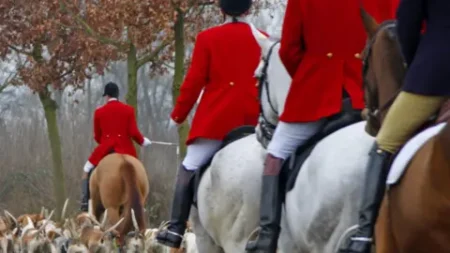



The ongoing tensions surrounding hunting in the UK remain palpable, two decades after fox hunting with dogs was officially banned. Byron John, a former fox hunt master, expresses a blend of defiance and weariness as he reflects on the relentless criticism that often labels participants as “murdering scum.” Despite nearly 20 years without legalized fox hunting, John finds himself in a desperate struggle to maintain the traditions and elements of hunting he cherishes greatly.
John became enamored with the sport as a child, and as a passionate advocate, he has dedicated himself to preserving certain aspects of hunting, albeit in forms that aim to comply with current laws. Alternative methods such as “clean boot hunting,” where human runners are pursued instead of foxes, have emerged. John has also taken steps to adapt by creating the Three Counties Bloodhound group, which trains dogs to follow human scent rather than the scent of animals like foxes. These adaptations are John’s responses to a “fight for survival” in a landscape where hunting has undergone significant transformation.
Contrasting John’s perspective is that of Dafydd Hughes, an ardent opponent of hunting who has devoted over 14 years to sabotaging hunts throughout North Wales. Hughes finds his fight against hunting situates itself on a moral battlefield, advocating for an outright ban of all forms of hunting, whether simulated or traditional. His deep-seated convictions were solidified after personal interactions with hunters, igniting a more direct approach to his activism. Hughes’ journey reflects a significant bifurcation in opinions regarding hunting, highlighting a societal divide that persists despite legislative changes.
Changes to hunting practices were catalyzed when the Hunting Act was enacted in 2004, leading to an environment where traditional hunting faced a reimagining. John notes that while the act marked the end of hunting as it was once practiced, it did not annihilate the spirit of the activity—rather, it ushered in new forms. Trail hunting, for instance, involves dragging a rag soaked in animal scent to tempt hounds without the intention of killing. However, skeptics warn that these practices may serve as disingenuous fronts for illegal hunting, complicating the narrative surrounding hunting today.
The landscape has shifted significantly, with rising tensions not just between hunters and saboteurs but also within the hunting community itself. John candidly observes a cultural divide, noting how older generations of hunters often view his adaptive approaches with disdain, seeing him as a traitor to the traditional practices they hold dear. On the other hand, the hostile encounters with activists who employ disruptive tactics illustrate a tense battle over public perception and moral stances on animal rights.
The use of social media has amplified the scrutiny of hunting practices, leading to greater awareness of any potential law-breaking by hunts. As John navigates these complexities, he feels that hunters are often unfairly judged, with public sentiment conflating all hunting practices irrespective of their adherence to legal standards. In pursuing what he believes is an honorable way to retain the tradition of hunting alive, John expresses concern that misunderstanding by the public and lawmakers could jeopardize trails like the one he spearheads.
From the perspective of organizations like the Countryside Alliance, the Hunting Act is functioning as intended, underscoring that illegal hunting should be met with repercussions. Spokespeople for the organization argue that saboteurs are unwelcome in rural communities, aiming to protect the integrity and welfare of both animals and the environment in which they operate.
As legislation and public sentiment toward hunting continues to evolve, John and Hughes embody the polarized views that characterize this age-old argument. Each side believes they are safeguarding essential elements of their culture, whether it be the tradition of hunting or the imperative of animal rights. In this ongoing conflict, the complexities of hunting traditions, legislative requirements, public morality, and individual passions are intricately woven together, reflecting a broader societal struggle to reconcile differing values and lifestyles.