

In a significant escalation of the ongoing conflict, Ukraine has reportedly fired UK-supplied Storm Shadow missiles at targets deep within Russian territory for the very first time. This marks a pivotal shift in Ukraine’s military strategy, as until recently, the use of these long-range missiles was restricted to operations within the nation’s borders. Following a series of approvals from Western allies, including the United States, Ukraine now appears to be taking a more aggressive stance as it seeks to counter Russian advances.
The news of the missile strikes coincided with Ukraine receiving permission from Washington to utilize U.S.-supplied weapons against Russian assets. This indicates a growing level of coordination between Ukraine and its Western allies, aimed at bolstering the nation’s military capabilities in an environment where Russia continues its offensive operations. The British Defense Secretary, John Healey, has confirmed dialogue with his Ukrainian counterpart, although details concerning specific operations remain classified for operational security reasons.
The U.K. government is engaging in careful deliberation regarding its public response to these escalating military actions, weighing the risks of repercussions from Russia, as well as managing the perception that the U.K. is driving Ukraine’s actions. Healey noted in comments made in the Commons that “Ukraine’s action on the battlefield speaks for itself,” highlighting the autonomy and decisive measures taken by the Ukrainian armed forces.
Ukrainian Defense Minister Rustem Umerov has also refrained from confirming the specific deployment of Storm Shadow missiles within Russian territory. However, he emphasized that Ukraine continues to “use all means” at its disposal to defend itself against the ongoing Russian invasion. In parallel, Matthew Miller, a spokesperson for the U.S. State Department, declined to provide insights into any navigational assistance being offered for the UK-supplied missiles, further shrouding the issue in ambiguity over collaboration on military matters.
President Volodymyr Zelensky has persistently urged his Western allies to enable the use of long-range missiles against Russian targets as a critical step towards achieving a resolution to the conflict. The Storm Shadow missile system is particularly favored for its capacity to penetrate fortified installations, such as military bunkers and ammunition depots used by Russian forces, thereby contributing strategically to the broader military objectives of Ukraine.
Previously, concerns regarding escalation limited the use of such capabilities, with both the U.S. and UK governments hesitating to grant permission for strikes against Russian territory. However, a recent shift was observed when U.S. President Joe Biden authorized Ukraine to employ the Army Tactical Missile System (Atacms), which subsequently saw action targeting the Bryansk region, adjacent to Ukraine.
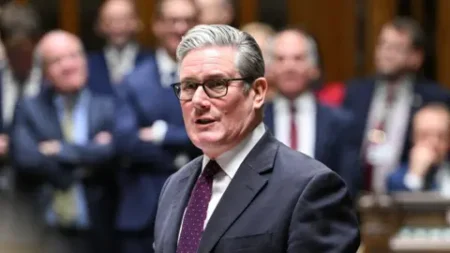
On the diplomatic front, the United States has also taken steps to support Ukraine further by approving the supply of landmines, aimed at impeding the movement of Russian troops. UK Prime Minister Sir Keir Starmer, speaking during the G20 summit in Rio de Janeiro, reiterated the commitment to provide Ukraine with the necessary support for as long as required.
The Storm Shadow, known in France as Scalp, is an advanced Anglo-French cruise missile with a range of approximately 250 kilometers (about 155 miles). It is designed to be launched from aircraft, flying low and fast to evade detection before executing high-impact strikes. Reports surfaced alleging the discovery of missile debris in Kursk, Russia, seemingly corroborating claims of Ukraine’s operational use of the Storm Shadow system, although experts have since debated the clarity of such evidence.
As the conflict unfolds, the implications of Ukrainian military strategies employing long-range missile technology could potentially reshape the battlefield dynamics, culminating in a more emphatic assertion of Ukraine’s defensive and offensive capabilities against Russian forces. The interplay between military actions and diplomatic dialogue among Western nations will undoubtedly play a significant role in determining the trajectory of the conflict moving forward.