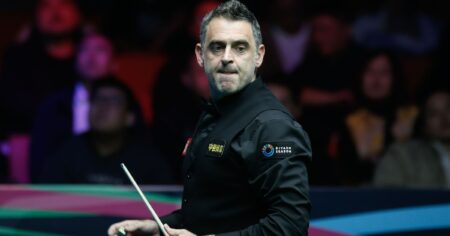



Renowned snooker player Ronnie O’Sullivan has recently advocated for the World Snooker Tour to employ a full-time mental health professional to assist players during competitions. This proposal comes from O’Sullivan’s own experiences, as he openly admitted to having grappled with depression, alcohol dependency, and substance misuse at various points throughout his illustrious career. By voicing this need for mental health support, O’Sullivan aims to shed light on an often overlooked aspect of professional sports, highlighting the mental turmoil that athletes can experience despite their outward success.
O’Sullivan, a seven-time world champion aged 49, expressed his concerns about the psychological pressures faced by players in the sport. Drawing parallels with football, where teams often have support staff such as masseuses to attend to physical injuries, he believes that snooker should implement a similar system for mental health. “I think World Snooker should have someone like in football,” he stated, emphasizing the essentiality of having a designated individual at each tournament who players can consult when they feel overwhelmed or mentally strained.
He pointed out that mental health struggles are prevalent among players, even if they choose to endure them quietly. O’Sullivan articulated, “For 10 minutes, if you need to come off the table [and talk] – I’m not saying everyone will go in there because a lot of players suffer in silence.” His observation reflects a nuanced understanding of the psychological ramifications that the pressures of high-stakes competition can impose on athletes. He noted that it is often visible to those around them when a player is struggling mentally, underscoring the necessity of providing a space for dialogue and support.
In his remarks, O’Sullivan also conveyed the critical nature of mental health in enhancing performance and enjoyment in the sport. “You have coaches sorting your cue action out, but really you need someone to just [help] unload a bit,” he stated, indicative of his belief that mental wellbeing significantly impacts players’ on-field performance. O’Sullivan’s call for action is further buoyed by the idea that existing panel members, like Shaun Murphy, could help garment the funding necessary for such a position within professional snooker.
He elaborated that if notable players like Mark Selby and John Higgins are experiencing mental struggles—and by extension, all competing players likely are—it dispels the myth that financial stability equates to mental wellbeing. O’Sullivan argues that even highly skilled and financially successful athletes are not immune to mental health challenges. “It’s not about the money. It’s about pride in performance,” he emphasized, highlighting that the desire to entertain and do well for audiences and oneself can sometimes become overwhelming.
O’Sullivan also touched on a personal anecdote detailing how even a brief interaction can alleviate mental burdens. “Sometimes just a five to ten minute chat and I’m alright… rather than going home and beating myself up,” he remarked, illustrating how vital it is for players to have access to a supportive ear when grappling with their thoughts and feelings.
In addition to O’Sullivan’s remarks, Mark Selby, another prominent figure in the snooker world, spoke candidly about his own journey with mental health. He indicated that he is currently managing his challenges better after seeking professional help from a doctor over the past year. Selby provided an analogy comparing the process of dealing with mental health issues to losing a loved one, where one learns to cope with the grief rather than entirely overcoming it. His insights further emphasize the need for comprehensive mental health support within the realm of professional sports.
In conclusion, both O’Sullivan and Selby’s powerful testimonies encapsulate the pressing need for mental health services in snooker. They advocate for the well-being of players, which, if addressed, can lead to improved performance, reduced stigma, and a healthier environment for everyone involved in the sport. A proactive step such as employing a mental health professional could significantly change how players perceive and handle their psychological challenges in tournaments.