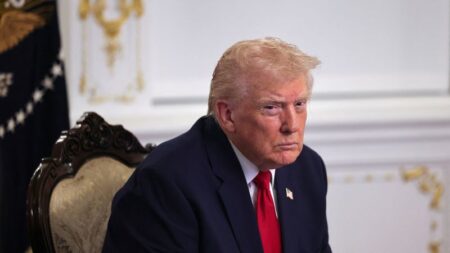


On a recent Friday, former President Donald Trump took to social media to reinvigorate his ongoing campaign to delegitimize actions from President Joe Biden’s administration. Within a post on Truth Social, Trump declared the cancellation of all executive orders and any other actions that were not directly signed by his predecessor, thereby raising a multitude of legal and political questions surrounding his claims and intentions.
In his proclamation, Trump made a point of highlighting his belief that any document signed by Biden using an autopen—an automated signature machine—should be considered null and void. Notably, he asserted that this method was used for approximately 92% of Biden’s executive actions, a detail he did not elaborate upon. His assertion that the autopen could not be employed without specific presidential approval provoked inquiries regarding the legal validity of such a claim. This raises the critical question of whether Trump possesses the authority to rescind prior executive actions based on the signature method used.
Trump’s rhetoric continued to escalate as he accused Biden of lacking involvement in the autopen process and suggested that if Biden claimed otherwise, he would face charges of perjury. The use of hyperbolic language is common in Trump’s communication style, and this instance was no exception. Expressing his belief that the “Radical Left Lunatics” surrounding Biden had unlawfully taken the presidency from him, Trump concluded his post with a dramatic assertion of canceling all executive orders not directly signed by what he referred to derogatorily as “Crooked Joe Biden.”
In stark contrast, President Biden has strongly refuted any allegations of a “cover-up” within his administration. He has emphatically declared that he has made all decisions during his presidency, labeling those who suggest otherwise as “liars.” This tit-for-tat highlights the ongoing partisan divide wherein accusations and rebuttals flow freely, often devoid of concrete evidence either way.
Trump’s fixation on Biden’s use of the autopen has been longstanding. In earlier statements, he argued that the president’s reliance on this tool indicated a lack of genuine leadership during his time in the White House, categorizing all such actions as essentially “null and void.” Political analysts and scholars, including conservative expert John Yoo, have weighed in on Trump’s claims, suggesting that Trump may simply be playing to his base in a bid to undermine Biden’s legitimacy rather than making claims grounded in legal reality.
Notably, Trump has also initiated investigations concerning Biden’s autopen use, claiming that it ties into the former president’s alleged cognitive decline. This echoes a common strategy within Trump’s rhetoric, where he seeks to delegitimize not only policies but the very person behind them.
Legal opinions surrounding the autopen are surprisingly robust, dating back to a 2005 review by the Department of Justice’s Office of Legal Counsel. Under President George W. Bush, the review concluded that a president need not physically sign a document to have it considered a lawful signature in the context of Article I, Section 7 of the Constitution. Further complicating Trump’s narrative, historical legal guidance has emphasized that the Constitution does not dictate a specific method for issuing pardons, a topic Trump has notably gravitated toward in his discussions.
Moreover, while a congressional investigation asserted that there are lingering questions about Biden’s awareness of certain pardons issued through the autopen, it failed to uncover any direct evidence indicating that Biden was not the one making the decisions regarding those pardons. This supports a broader consensus that Trump’s claims—while politically charged—may find themselves at odds with established legal precedents and the complexities intrinsic to executive power.
In summary, Trump’s recent declarations concerning executive orders signed by Biden reflect an attempt not only to rally his loyal supporters but also to challenge the legitimacy of his successor’s presidency. Whether these claims possess any real legal weight remains a contentious issue, with numerous legal experts and historical context suggesting that the foundations upon which Trump constructs his argument may be more tenuous than he believes.