
The European Union (EU) has taken a significant step by agreeing to indefinitely immobilize Russian assets totaling approximately €210 billion (£185 billion), which have been frozen since the onset of Russia’s extensive invasion of Ukraine. This strategic move has sparked discussions surrounding the potential use of these funds to bolster Ukraine’s economy, particularly in its ongoing military fight and recent reconstruction efforts. European leaders are aiming to finalize an agreement at an upcoming pivotal EU summit that could authorize a loan utilizing the frozen assets, ensuring vital financial support for Ukraine at a time when its resources are dwindling.
The frozen assets are primarily situated in Euroclear, a Belgian banking institution, and can play a critical role in funding Ukraine’s estimated immediate financial needs, which exceed €135.7 billion (£119 billion; $159 billion) over the next two years. European nations are gearing up to contribute two-thirds of this deficit, but Russian authorities have sharply criticized the EU, labeling their intentions as theft.
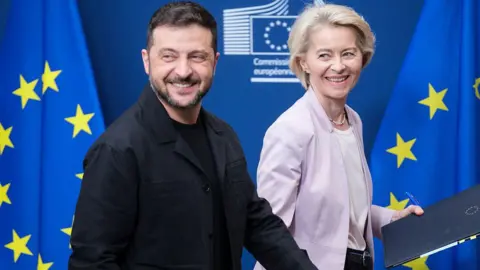
In response to the proposed loan plan, the Russian Central Bank has initiated legal proceedings against Euroclear in Moscow, showcasing Moscow’s pushback against what it views as illegal appropriation of its assets. Both Ukraine and the EU argue that utilizing the frozen funds to rebuild war-torn areas is “only fair.” Ukrainian President Volodymyr Zelensky emphasized the importance of repurposing the funds for reconstruction, while German Chancellor Friedrich Merz underlined that these assets could be instrumental for Ukraine’s long-term defense against future aggressions.
Since the freezing of the assets commenced in February 2022, following the invasion, the financial landscape has significantly evolved. The EU plans to refer to the use of these funds for reconstruction as a “reparations loan,” with an ambitious proposal of approximately €90 billion aimed at rejuvenating Ukraine’s economy. However, Belgium is raising concerns about the financial implications and legal ramifications if any complications arise from the loan plan. They are advocating for robust guarantees to mitigate any risks associated with undertaking substantial financial obligations, reflecting a broader apprehension shared among EU member states regarding the situation.
Amid the ongoing tensions, Belgium’s Prime Minister Bart De Wever has voiced strong concerns over potential liabilities that may arise from the EU’s plan. The fear is that if the situation regarding these funds turns problematic, Belgium may find itself carrying significant financial responsibility, which could threaten its economic stability.
Recognizing this, discussions are continuing within the EU to secure a solution that alleviates Belgium’s concerns while maintaining momentum for the aid to Ukraine. There are currently two proposals being debated within the EU — one involves raising funds on capital markets underwritten by the EU budget, which is seen as the preferable option for Belgium; however, achieving the necessary unanimous agreement among member states could prove challenging. The alternative would see loans directly drawn from the frozen Russian assets, which presents its own complexities as these assets were initially invested in securities.
EU officials have indicated that they are aware of Belgium’s legitimate concerns and believe that they can provide adequate protections against potential financial fallout. The proposal includes a guarantee covering all €210 billion of Russian assets in the EU, ensuring that if Euroclear experiences losses due to Russian actions, it can be compensated from Russia’s own holdings in European financial institutions.
Furthermore, EU ambassadors recently invoked an emergency clause to ensure the indefinite immobilization of Russia’s assets, which reflects a concerted effort to protect the European economy while reinforcing their solidarity with Ukraine. Sweden’s Finance Minister Elisabeth Svantesson remarked that this decision represents a significant advancement in reinforcing support for Ukraine amidst ongoing challenges to European stability and security.
However, rising tensions within the EU are compounded by external pressures, particularly from the US, which is also exploring how to handle Russian assets for potential peace initiatives. This multi-faceted negotiation landscape indicates an evolution not only in the financial intricacies concerning Ukraine but also in broader geopolitical relations. With time being of the essence, EU member states are keen to find a sustainable resolution that supports Ukraine’s defense efforts while safeguarding their own economic interests from potential repercussions by Russia.