


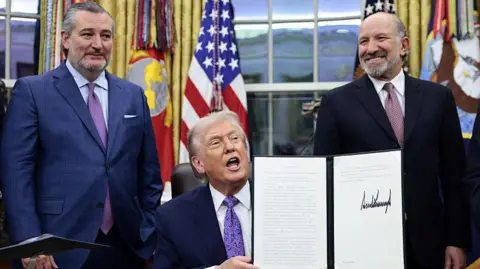
U.S. President Donald Trump has recently enacted an executive order intended to prevent states from imposing their own regulations on artificial intelligence (AI). This directive was signed in the Oval Office, where Trump emphasized the need for a unified regulatory approach for AI technologies. According to Trump, the initiative aims to consolidate control and oversight at the federal level, enhancing efficiency and coherence in the fast-evolving AI industry.
The impetus for this executive order is rooted in a desire to streamline policies that could significantly influence America’s competitive edge in AI. David Sacks, an AI advisor at the White House, mentioned that the federal government would reject particularly burdensome regulations set by individual states. He clarified, however, that regulations ensuring children’s safety in relation to AI would still be respected and enforced. This nuanced approach appears to be designed to balance the needs of technology companies with societal safety concerns.
The ruling is viewed as a significant victory for tech giants advocating for a uniform regulatory framework across the United States. Many of these companies argue that disparate state-level regulations could stifle innovation, particularly as billions of dollars are being invested in AI technology amid stiff global competition, particularly from China. The fear is that a patchwork of regulations could lead to inefficiencies and hinder progress in the industry.
Nonetheless, the initiative to preempt state laws has ignited a wave of criticism. Currently, over one thousand AI-related bills have been proposed at the state level, reflecting a robust legislative interest in regulating the rapidly advancing field. This year alone, 38 states, including California—home to a multitude of leading technology firms—have enacted about 100 AI regulations, as reported by the National Conference of State Legislatures.
The scope of these state laws varies significantly. For instance, California has mandated that technology platforms frequently inform users when they are interacting with a chatbot, aiming to safeguard children and adolescents. In addition, the state has instituted regulations requiring major AI developers to outline measures to mitigate risks linked to their AI systems. Meanwhile, North Dakota has introduced a law prohibiting the use of AI-driven robots for harassment or stalking, showcasing the diversity of approaches taken by states in an attempt to protect their citizens.
Critics of the executive order argue that state-level regulations are vital due to the absence of comprehensive federal guidelines. Julie Scelfo from the advocacy group Mothers Against Media Addiction expressed concern that dismantling state laws impairs their rights to implement necessary protections for residents. This perspective highlights a deep divide in how regulation in the AI space is perceived; some view federal control as essential for progress and innovation, while others see it as an encroachment on states’ rights to safeguard their populations.
California Governor Gavin Newsom, a prominent critic of Trump, further escalated the pushback against the executive order, accusing the president of capitulating to the interests of the technology industry. Newsom’s statement suggested that the move merely serves to enrich Trump and his associates while potentially putting citizens at risk from unregulated AI technologies.
Responses from the AI industry have been mixed. Companies like OpenAI, Google, and Meta have yet to issue formal comments regarding the executive order. However, the decision has garnered approval from tech advocacy group NetChoice, highlighting a collective eagerness to engage with the White House in establishing nation-wide standards and regulations for the rapidly expanding sector.
Michael Goodyear, an associate professor at New York Law School, weighed in on the effectiveness of the order, arguing that a singular federal law is preferable to conflicting state regulations. However, he also cautioned against assuming that federal laws would be adequately protective or beneficial. This encapsulates the broader concern that, while uniformity may streamline regulation, it may not always lead to the best outcomes for society as a whole. The ongoing debate about how best to regulate AI underscores the intricate balance between fostering innovation and ensuring safety and accountability in an era marked by unprecedented technological advancement.