


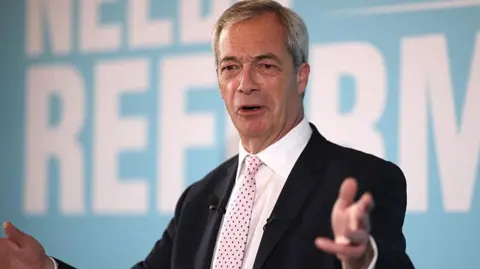
In a recent development regarding electoral law and campaign financing, the Electoral Commission has declared there is no credible evidence to suggest that Nigel Farage, leader of Reform UK, violated electoral laws during his campaign activities. This statement follows previous claims made by members of Farage’s campaign team that expenditures exceeded the legal limit of £20,660. According to correspondence shared with the BBC, the watchdog has formally decided to take no further actions concerning the allegations.
The controversy arose when a former member of Farage’s campaign, Richard Everett, alleged that the party had misreported expenses related to campaign materials such as leaflets and banners, as well as utility bills and renovations at their office in Clacton. However, the Electoral Commission’s analysis did not uncover any omissions of spending that needed declaration, concluding their inquiries with a formal statement indicating that they found no credible evidence of electoral law violations. The commission emphasized that they had conducted an extensive review and ultimately decided to close the case.
In parallel, Essex Police announced that they would not pursue an investigation into the claims, citing that the allegations had been reported too late, beyond the one-year statute of limitations for prosecuting such electoral offences. The complaint regarding the alleged misreporting of expenditures had been lodged on December 5, 2024, whereas the supposed offences occurred in July 2024, hence exceeding the legal timeframe for any prosecution.
Peter Harris, the election agent for Farage in Clacton, strongly defended the campaign, claiming that the allegations against Farage were politically motivated. Harris expressed confidence in the transparency of the campaign’s financial practices and stated unequivocally that there was no foundation for the allegations being circulated. He echoed the sentiments of the Electoral Commission, which also documented in its letter that there was no basis to continue further investigations into the campaign’s expenditure practices.
Following his leadership takeover of Reform UK in June 2024, just weeks before the general elections, Farage successfully won the Clacton constituency, defeating the Conservative candidate with a substantial majority of over 8,000 votes. This significant victory, however, is now shadowed by the accusations concerning campaign financing which originated during the tumultuous electoral period.
The fallout from these allegations has sparked broader discussions on the integrity of campaign finance within the political sphere in the UK. Critics have pointed out that even the appearance of impropriety can severely undermine public trust in political actors and their commitments to transparency. As political campaigns become increasingly scrutinized, the necessity for awe-inspiring compliance with electoral regulations becomes ever more paramount.
As it stands, Nigel Farage and Reform UK seem to have weathered this particular storm, with the Electoral Commission and Essex Police both exonerating them from the allegations of mismanagement. The political landscape remains intricate and fraught with challenges, particularly around trust and accountability in campaign financing. The resolution of this situation will likely resonate through upcoming elections, affecting both voter perceptions and future electoral strategies.
Moving forward, both Farage and his party will need to maintain a keen focus on transparency in campaign financing to restore any trust that may have been affected by recent controversies. As new electoral campaigns approach, the implications of this ruling may continue to unfold, offering an opportunity for ongoing dialogue about the governance of political campaign spending in the UK.