

The ongoing tensions between the United States and the European Union have taken a new turn as the U.S. State Department has announced a travel ban targeting five individuals, including former European Commissioner Thierry Breton. This decision stems from perceived attempts by these individuals to manipulate American social media platforms in a bid to suppress dissenting viewpoints. Secretary of State Marco Rubio articulated the rationale behind this move, characterizing the involved parties as “radical activists” associated with certain non-governmental organizations (NGOs) that purportedly promote censorship measures, aimed at American speakers and companies.
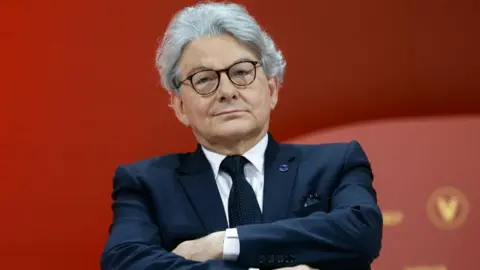
Thierry Breton, who served as the EU’s top digital regulator and was instrumental in the creation of the Digital Services Act (DSA), is at the forefront of this controversy. The DSA has implemented stringent content moderation requirements for social media platforms within the European Union. The U.S. government has labeled Breton a “mastermind” of this act, suggesting that the regulations he championed contribute to a culture of censorship viewed as oppressive, especially among U.S. conservatives who argue that the DSA unfairly targets right-wing perspectives. Breton, in response to the visa denial, described the situation as a “witch hunt,” indicating that he perceives a broader campaign against free expression occurring within the U.S. political landscape.
The conflict escalated particularly after the European Commission imposed a hefty fine of €120 million on X (formerly Twitter) for misleading practices related to its verification system. This fine marked the first enforcement action under the DSA and captured the attention of Elon Musk, who has criticized European regulations as overreaching and burdensome. Following the financial penalty, the social media platform took retaliatory steps by blocking the European Commission from advertising on its service, reflecting the animosity that has grown between Musk and the EU regulatory framework. Musk’s resistance against EU policies exemplifies the mounting strain in transatlantic relations regarding digital governance and free speech.
As reactions poured in concerning the U.S. visa bans, Breton utilized the social media platform to convey a message to his American counterparts: “Censorship isn’t where you think it is.” This statement reflects a profound concern regarding the perceived encroachment on free speech, particularly favoring certain narratives over others. The complexity of the situation is further heightened by the inclusion of Clare Melford, director of the U.K.-based Global Disinformation Index (GDI), in the travel ban list. Criticism of the GDI, with accusations of using U.S. taxpayer funds for censorship initiatives, has come from U.S. officials like Undersecretary Sarah B Rogers. The GDI’s representatives have condemned the travel bans as authoritarian measures that threaten free speech.
Notably, the organization’s spokesperson condemned the visa restrictions as government censorship, asserting that such moves represent an immoral and unlawful repression of dissenting voices. Meanwhile, Imran Ahmed, representing the Center for Countering Digital Hate (CCDH), is also banned from entering the United States. Rogers has labeled Ahmed a collaborator with the Biden Administration in efforts to leverage governmental power against citizens to stifle dissent amid the growing discourse on digital hate and accountability.
Additional figures affected by this visa ban include Anna-Lena von Hodenberg and Josephine Ballon of HateAid, an organization cited by the State Department for its support in enforcing the DSA. They decried the ban as an egregious act of repression by a government intent on silencing its critics, stating their resolve to remain undeterred by punitive actions. The culmination of these events underscores a pivotal moment in which U.S. policy seeks to counteract what it perceives as foreign overreach in its domestic information landscape, underlining the nuanced dynamics between free speech, regulation, and international relations. Rubio has emphasized a commitment to halting foreign censorship that infringes upon American sovereignty, spotlighting the broader implications of the digital discourse on world politics.