

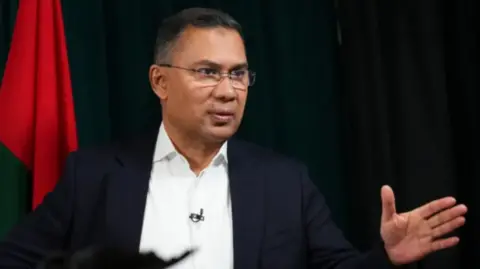
In a significant political development, Tarique Rahman, widely recognized as the front-runner for the position of Prime Minister of Bangladesh, has made his return to the country after a long exile of 17 years. His arrival coincides with a politically charged atmosphere as Bangladesh approaches crucial general elections, marking a pivotal moment in the nation’s political landscape.
Tarique Rahman, aged 60, is not only the son of former Prime Minister Khaleda Zia but also serves as the prominent leader of the Bangladesh Nationalist Party (BNP). The BNP is looking to reclaim power in light of the upcoming elections, a contest that many believe will shape the future of Bangladeshi governance and policy. Rahman’s leadership is especially significant as the party seeks to regain influence following years of opposition under the rule of Sheikh Hasina’s Awami League party.
Rahman has spent the majority of his exile in London since 2008, notably needed to navigate various legal challenges and political turmoil during Hasina’s administration. His return ignites the possibility of a BNP revival, a move anticipated to invigorate the party’s supporters and re-establish its presence in the political arena. If Rahman can channel the energies of the BNP base effectively, it is plausible that he could ascend to the role of the country’s leader, provided the party secures the largest number of seats in the elections slated for the new year.
The context of Rahman’s return is intrinsically linked to the political downfall of Sheikh Hasina, who was ousted from office last year amidst a swirl of protests and allegations of human rights violations. While in power, Hasina’s administration had initiated several criminal investigations against Rahman, yet all charges against him were dismissed when her regime collapsed. Noteworthy is that Hasina currently resides in exile in India, and her party’s involvement in the upcoming elections is marred by uncertainty, with many analysts projecting that it may be barred from participation altogether.
In the aftermath of her downfall, Hasina has been sentenced to death for her involvement in suppressing anti-government protests, with reports from UN investigations revealing a staggering death toll of approximately 1,400 during the unrest led predominantly by students. This politically charged backdrop sets a dramatic stage for Rahman’s re-emergence, as he could potentially lead the nation away from the legacies of violence and oppression associated with the previous government.
Support for Rahman is uniquely palpable, with BNP supporters gathering in Dhaka in vibrant displays of allegiance as they welcome their leader back to the homeland. His status as part of the influential Zia family adds another layer of intrigue to his political resurgence, as family legacies in South Asian politics often carry significant weight in shaping public perception and loyalty.
At this juncture, the unfolding political drama in Bangladesh resonates not only within the nation’s borders but also on the international stage, given the implications it has for regional stability and governance. With the spotlight now fixed on Rahman and the forthcoming elections, the next chapter in Bangladesh’s storied political history is set to be defined by the interactions between old rivalries, shifting allegiances, and the hopes of a populus fervently seeking change.
As the nation braces for electoral contests that could redefine its political dynamics, Rahman’s return offers a mixture of anticipation and anxiety about what the immediate future holds for Bangladesh’s governance and political ethos. The outcomes of these elections are likely to resonate well beyond the country’s borders, influencing regional politics in South Asia and setting a precedent for governance practices influenced by historical narratives and current realities.