



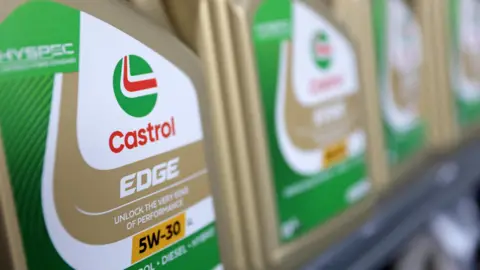
In a significant business maneuver, BP has finalized a substantial agreement worth $6 billion (£4.4 billion) that involves the sale of a majority stake in its renowned motor oil division, Castrol. This transaction is notably targeted towards Stonepeak, a private investment firm based in New York. The sale encompasses a 65% share of Castrol, a brand that specializes in manufacturing lubricants intended for vehicles such as cars, motorcycles, and industrial machinery.
The deal valued Castrol at an impressive $10.1 billion (£7.5 billion). As part of the agreement, BP will receive the aforementioned $6 billion in cash, which the company intends to leverage primarily for reducing its debt load. Additionally, this financial influx will enable BP to concentrate more intently on its core business efforts, signifying a pivotal shift in its strategic direction.
Despite the sale, BP is committed to retaining a 35% interest in Castrol, a subsidiary it initially acquired back in 2000. This aspect of the deal indicates BP’s continued faith in Castrol’s potential for growth and profitability, even as the conglomerate embarks on a broader plan to revamp its business model and address financial efficiency.
The oil titan characterized this sale as a “milestone” in its strategic reorientation aimed at simplifying operations and cutting costs. In February of this year, BP proclaimed plans to divest assets worth $20 billion (£15 billion) as part of its effort to refocus on its principal activities in crude oil and natural gas, while simultaneously fortifying its financial standing. This move comes amid increasing pressure from shareholders and investors who have expressed dissatisfaction with BP’s performance, particularly in comparison to its competitors.
As the landscape of energy companies shifts, BP is not alone in recalibrating its focus. Major rivals, including Shell and Norwegian company Equinor, have similarly adjusted their strategies regarding investments in renewable energy. This arises in response to changing market conditions and a discernible pressing from some sections of the investment community, leading BP to reassess its earlier commitments to green energy initiatives. These dynamics come against a backdrop of increasing political advocacy for fossil fuel investment, notably highlighted by former US President Donald Trump’s famous slogan, “drill baby drill.”
This latest initiative involving the sale of Castrol coincides with a pivotal transition in BP’s leadership. A week prior to the sale announcement, BP revealed that it would be appointing Meg O’Neill as its first female chief executive, a notable milestone set to take effect in April 2026. O’Neill’s unexpected selection follows the recent appointment of Albert Manifold as chairman and occurs less than two years after Murray Auchincloss succeeded Bernard Looney in the role of CEO. These leadership changes reflect a time of significant transformation within BP, suggesting a proactive approach to governance amid the prevailing business challenges.
The Castrol divestiture represents just one aspect of BP’s evolving portfolio, which in recent months has included disposing of its US onshore wind energy division and its mobility and convenience segment in the Netherlands. Interim Chief Executive Carol Howle articulated that the transaction signifies a “very good outcome for all stakeholders” involved, emphasizing the importance of simplifying operations while focusing on the company’s leading integrated business segments as they accelerate organizational plans.
In summary, BP’s sale of its Castrol stake is a considerable strategic maneuver that highlights the company’s response to evolving market dynamics and internal performance pressures. The deal, while reducing BP’s proportion in the lubricant sector, affirms its enduring commitment to leveraging existing business frameworks to enhance overall profitability and operational efficiency. As the energy sector continues to shift, BP’s strategic prioritization illustrates an adaptive approach in navigating past challenges towards potential future successes.