


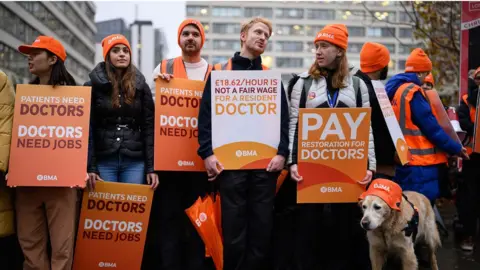
In a significant development regarding healthcare labor relations, doctors in England have voted to proceed with a five-day strike this week despite receiving a new offer from the government. This decision was confirmed by the British Medical Association (BMA), which indicated that a substantial 83% of its members endorsed the continuation of the strike action through an online poll conducted over the weekend. The turnout for this poll was notable, recorded at 65%, reflecting a robust engagement among the doctors on this pivotal issue.
The backdrop to this strike deliberation includes a recently announced government proposal that aims to increase specialty training positions and cover out-of-pocket expenses, such as examination fees for doctors. The urgency of these negotiations arose from ongoing stress on the healthcare system, exacerbated by the flu season. Notably, Health Secretary Wes Streeting criticized the strike’s timing, labeling it as “irresponsible and dangerous,” particularly as hospitals face overwhelming pressures due to rising flu cases. The strike by resident doctors is scheduled to commence at 07:00 on Wednesday, marking a critical moment for healthcare services in the region.
Despite the government’s efforts to negotiate, the union has pointed out the absence of any financial commitment in the new offer regarding pay adjustments. Secretary Streeting has firmly refused to negotiate on salary terms, arguing that the remuneration for resident doctors has been raised by nearly 30% over the past three years. However, the BMA contends that adjusting for inflation shows that the real wages for these doctors have plunged to a fifth below their levels in 2008. In response to this contention, Streeting dismissed the union’s pay demands as “fantasy,” stating that the BMA has unilaterally chosen to initiate strikes during a period of escalating healthcare challenges.
As the situation develops, it is essential to consider the implications of flu strains currently affecting the population. Data indicates that the number of patients hospitalized with flu has surged by over 50% in a single week, crossing the significant threshold of 2,600 in early December. This year’s flu season came relatively early and is being described as particularly severe, with the H3N2 strain causing more aggressive illness compared to previous years. Compounding the pressures on healthcare facilities, this walkout is marked as the fourteenth strike in a prolonged dispute that began in March 2023. Resident doctors, who make up nearly half of the medical workforce, will be involved in both emergency and non-urgent care services, with senior medical staff stepping in to fill the gaps.
Dr. Jack Fletcher, a prominent figure within the BMA, emphasized the overwhelming response from the membership as a clear indication of the government’s failure to appropriately address doctors’ concerns. He articulated that many frontline doctors feel that the government’s latest offer is insufficient, stating it is “too little, too late.” He reaffirmed the union’s commitment to patient safety and their intention to coordinate closely with NHS England during the strike.
Adding to the narrative, Rory Deighton, representing the NHS Confederation, expressed disappointment over the BMA’s decision to reject the government’s proposal, stating that such strikes are particularly disruptive and ill-timed given the emerging health crisis posed by flu. Had BMA members chosen not to proceed with the strike, it would have instigated a new evaluation on the government’s offer, potentially paving the way for resolution. However, with the continuation of the strike action, the healthcare landscape remains strained, bringing to the forefront the ongoing discussion regarding compensation and working conditions for doctors within the NHS.