


The ongoing political discourse surrounding the upcoming Budget has taken a significant turn as Downing Street has officially refuted claims made by Rachel Reeves regarding the state of the public finances. The controversy stems from statements made by Reeves, who is the Chancellor of the Exchequer, before the anticipated Budget announcement scheduled for Wednesday. Critics within the Conservative Party have accused her of providing a misleadingly grim overview of the UK’s economic situation, suggesting that her comments serve as a smokescreen to justify potential tax increases.
In the lead-up to this Budget, Reeves made various remarks highlighting a recent downgrade in the UK’s forecasted economic productivity, hinting that these developments could hinder her ability to adhere to set spending rules. However, the tensions escalated when Richard Hughes, Chairman of the Office for Budget Responsibility (OBR), communicated to Members of Parliament (MPs) in a letter that certain positive forecasts, including projected rises in wages, were not discussed by Reeves and could actually support her financial framework.
The Conservative Party, led by figures like Kemi Badenoch, has been vocal in their criticism, asserting that Reeves has intentionally misled the public. Badenoch has gone as far as to claim that Reeves’ misrepresentations warrant her dismissal from office. The OBR’s letter indicated that Hughes had informed the Chancellor back in September that the public finances were in a healthier state than previously anticipated.
As the political storm brewed, Hughes also clarified that the Treasury was likely to meet its primary objective of avoiding borrowing for day-to-day operations, though only by a margin of £4.2 billion—much less than the £9.9 billion buffer she had set aside in prior assessments. Emphasizing her viewpoint, Reeves had warned in early November about the country’s lower productivity and its adverse effects on taxation revenues during a pre-Budget address she delivered at Downing Street.
During interviews, including one on BBC Radio 5 Live, Reeves acknowledged that maintaining manifesto commitments was feasible but would necessitate severe cuts in capital spending—a statement that further fueled speculation about imminent tax hikes. Nevertheless, the OBR has indicated that while productivity forecasts have declined, a surge in wages is expected to enhance government tax revenues, positioning Reeves potentially to meet her fiscal objectives successfully.
In response to the mounting criticisms, a spokesperson from the Treasury maintained neutrality on the OBR’s internal procedures while defending Reeves’ decisions regarding the Budget. They highlighted her focus on alleviating the cost of living crisis and managing public health issues. Additionally, the spokesperson asserted that the government has successfully created additional fiscal leeway to comply with budgetary regulations, thereby imparting a sense of stability for businesses.
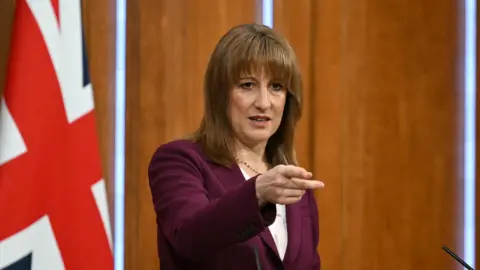
Yet, despite official statements aimed at grappling with the vitriolic discourse surrounding her fiscal policy, Reeves has continued to indicate a possible rise in income tax rates. In her recent Downing Street press conference, she reiterated that the productivity performance was not as robust as previously believed, intending to prepare the public for the challenges ahead.
Ultimately, while Reeves withdrew from escalating income tax rates, her Budget still forecasted £26 billion in tax increases, primarily achieved through the freezing of income tax thresholds over the next three years. Sir Mel Stride, a leading member of the Conservative Party, claimed that while Reeves persistently emphasized recent downgrades in productivity, she consciously omitted the forecast indicating how rising wages could counterbalance these reductions in productivity.
The growing tension between the two leading parties underscores a larger narrative of the prevailing economic climate and governmental transparency regarding fiscal matters. As the Budget announcement looms, the stakes are high and the political arena remains charged, with economic policies and their implications for the public being put under intense scrutiny.