

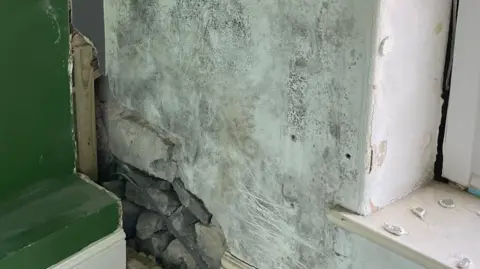
The Wadley family’s Christmas plans have been profoundly disrupted due to an unfortunate situation stemming from improper insulation installation. Tony and Becs Wadley, who reside in the picturesque Gower Peninsula, have revealed that a government-funded insulation scheme resulted in serious issues, most significantly, the presence of black mold in their home. As a consequence, their 19-year-old son, Elliott, who suffers from asthma, is unable to stay in their house due to health concerns. Mr. Wadley’s distress is palpable as he expresses how heartbreaking it is for his son to feel alienated from their own home. “It’s awful. Elliott can’t come into our house, it’s as if he’s been ostracized from his own home,” he stated, highlighting the emotional toll this situation has taken on the family.
This family is just one of many, as more than 300 individuals have approached the BBC to narrate their own experiences regarding flawed insulation installations. The widespread nature of these issues raises significant concerns, prompting reactions from the Department of Energy Security and Net Zero (DESNZ). In response, the DESNZ acknowledged that measures are being implemented to prevent consumers from experiencing such disappointments in the future.
Tony and Becs Wadley originally received a government grant aimed at improving their home’s energy efficiency, with the hope that a warmer environment would help alleviate Elliott’s asthma. This assistance included funds for insulating Elliott’s bedroom walls. However, after the installation, black mold began to proliferate behind the insulation boards. The installer attempted to remedy the issues by removing the contaminated materials, replacing them with new insulation. Unfortunately, the second installation also failed, necessitating the removal of not only the new insulation but also the wall plaster, leading to a situation where Elliott has not been able to return home since April. “I miss him like you wouldn’t believe,” confesses Mrs. Wadley, underlining the family’s emotional distress.
To celebrate Christmas, the family has decided to stay with Mr. Wadley’s sister to remain united, as their home is no longer a safe space for Elliott. It should be noted that billions have been invested by the government over the past 15 years in home insulation initiatives; however, these expenditures often lack follow-up due diligence. The Wadleys’ home insulation was completed under the ECO4 scheme, which has recently come under scrutiny. A report from the National Audit Office (NAO) revealed alarming statistics, noting that 98% of homes insulated through various government schemes had major problems requiring repairs. This highlights a substantial oversight on the part of the government and the organizations responsible for overseeing such installations.
The DESNZ states that it “inherited a flawed system of oversight and regulation,” and is determined to implement comprehensive reforms through the upcoming Warm Homes Plan. The goal is to ensure consumers receive quality installations and that similar failures do not occur again. A spokesperson emphasized that homeowners should not be left to navigate complicated bureaucracies when seeking improvements in their residences.
Adding to this narrative, the situation reflects not only on the Wadley family but on numerous others adversely affected by similar insulation problems. Take, for instance, the experience of Scott Proudman, who reported issues with external wall insulation on his Bristol home. His family’s aspiration to improve their living conditions under a government scheme has devolved into a nightmare, as they face a potential repair bill of £20,000. This situation is further compounded by the fact that the installer responsible for the work is now liquidated, leaving customers with no recourse for the failures experienced.
In summary, these instances underline a pressing need for reform in the oversight of home improvement programs, as the implications are significant for families hoping to enhance their living conditions. The Wadleys and other affected families serve as poignant reminders of the realities of poorly executed government initiatives – necessitating an urgent call for action and accountability to prevent such distressing circumstances from recurring in the future.