


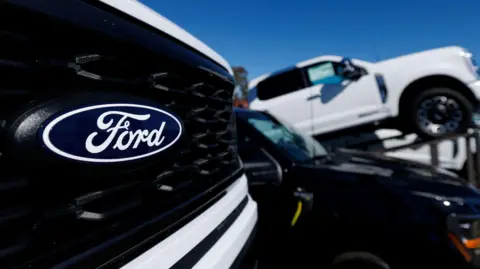
Ford Motor Company has made significant adjustments to its electric vehicle (EV) strategy, announcing a major pivot away from plans to manufacture larger electric vehicles. On a recent Monday, the American automotive giant revealed plans that explicitly reflect its awareness of changing market dynamics, citing below-par demand for large EVs and new regulatory policies under the administration of former President Donald Trump. As a result, Ford is poised to scale back its investments, resulting in an anticipated financial hit of $19.5 billion (approximately £14.6 billion).
This strategic shift signifies a significant change in Ford’s approach to electrification. The company has decided to redirect its focus toward manufacturing hybrid and gasoline-powered vehicles, as well as smaller, more cost-effective electric models. The decision has been attributed to a combination of factors, including an unexpected drop in demand for EVs, increased production costs, and regulatory changes that have reduced the incentives available for the electric vehicle market. With these projections in hand, Ford stated in an official release that the previous business case for heavily investing in the production of large EV models has “eroded.”
Jim Farley, the Chief Executive Officer of Ford, mentioned that there has been a “customer-driven shift” steering the company toward offerings that are more profitable and resilient. In his statement, Farley emphasized that the operational realities surrounding automotive manufacturing and consumer preferences have shifted. Consequently, Ford is reallocating its capital towards more lucrative avenues such as trucks, vans, hybrid vehicles, and its energy storage solutions. This comprehensive adjustment underscores a profound pivot in how Ford perceives market health and consumer direction in the automotive landscape.
Notably, Ford has also announced that it will halt plans to produce a purely electric variant of its best-selling F-150 pickup truck. Instead, the company will innovate its F-150 Lightning model as a hybrid vehicle featuring a gasoline generator. Additionally, plans for a new electric van have been shelved, refocusing efforts on gas-powered and hybrid models. This decisive action home to the F-150 lineup is significant, as the truck has long been a critical contributor to Ford’s brand identity and revenue stream.
Ford’s decision to adjust its EV plans aligns with the recent moves by other major players in the automotive market. General Motors, for example, has also announced substantial changes to its electric vehicle ambitions, acknowledging similar challenges and anticipating a $1.6 billion hit in their financial forecasts. Both companies have been affected by a broader trend where electric vehicle adoption in the United States has not progressed at the speed seen in other markets, such as China and Europe, largely due to lackluster governmental support.
Since assuming office, the Trump administration has initiated several measures that rolled back incentives and restructured regulations that were previously viewed as beneficial for electric vehicle adoption. One notable change was the discontinuation of a government subsidy, which had offered financial incentives of up to $7,500 (£5,608) for specific electric and hybrid vehicles. The removal of these tax credits was anticipated to impede the momentum of EV sales, a sentiment that Farley shared, indicating the expectation that the EV market would be “smaller, way smaller than we thought.”
Furthermore, the Trump administration recently announced plans to relax fuel economy standards that had been established under the Biden presidency. These Biden-era policies aimed at environmental sustainability projected to prevent more than 700 million metric tons of carbon emissions by the year 2050, which has elicited criticism from environmental advocates who see the rollback as a significant step in the opposite direction for public health and the industry.
In light of these developments, Ford is recalibrating its operational strategies in alignment with what it perceives to be the changing landscapes of consumer demand and regulatory realities. The future direction of the company will likely reflect an emphasis on profitability, through models that resonate with current market conditions and consumer preferences, setting a path forward amid challenges faced in the evolving automotive marketplace.