

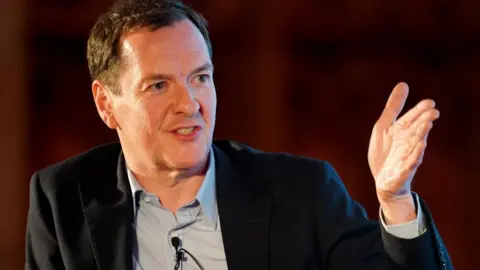
Former Chancellor George Osborne has recently announced his new role at OpenAI, stepping into the pivotal position of leading the company’s “OpenAI for Countries” program. This initiative is dedicated to empowering governments around the world to expand their artificial intelligence capabilities. Osborne’s decision to join OpenAI marks a significant transition from his previous dealings in politics and finance, indicating a profound interest in the transformative potential of AI technology.
Upon announcing his new role, based in London, Osborne expressed his enthusiasm by stating, “It is a privilege to be joining the company.” He reflected on his choice by asking himself, “what’s the most exciting and promising company in the world right now?” His newfound admiration for OpenAI aligns well with the broader dialogue surrounding the urgent need for responsible AI governance and development strategies.
The context of Osborne’s appointment comes at a time when discussions regarding AI infrastructure and technology partnerships between governments, notably the UK and the US, have faced challenges. Chris Lehane, OpenAI’s Chief Global Affairs Officer, highlighted the significance of Osborne’s addition to the team, noting that it represents a shared conviction that AI is increasingly viewed as critical infrastructure. The early decisions regarding how AI is constructed, governed, and employed will have lasting impacts on the global economic landscape and geopolitical relationships.
The “OpenAI for Countries” program is designed to partner with governments to ensure that AI systems, which will inevitably play a crucial role in shaping the future, are grounded in democratic values. With engagement from over 50 countries already, the initiative aims to bolster AI literacy and enhance public services through better AI infrastructure. Lehane pointed out that Osborne’s experience will be instrumental in expanding existing relationships as well as forging new collaborations.
In his remarks, Osborne underscored the majority sentiment that the key leaders of OpenAI—Sam Altman, the company’s CEO, and Brad Lightcap, COO—are deeply committed to fostering a responsible approach toward AI development. He stated that their impressive leadership qualities and dedication to equitable technological benefits motivated his decision to join the team. Osborne further articulated that one of the primary objectives of the OpenAI for Countries initiative is to ensure that societies worldwide can reap the rewards of AI technology.
Despite the promise of this new opportunity, Osborne acknowledged the difficulty of leaving his role at investment bank Evercore, describing it as a “huge wrench.” His career has spanned various significant positions, including his time as the editor of the Evening Standard newspaper from 2017 to 2020. His multi-faceted background underpins his capability to navigate the complex interplay of technology, governance, and public service.
This announcement also coincides with ongoing discussions from Downing Street about maintaining active negotiations with the US government regarding a comprehensive tech partnership. A tech deal, which was first introduced in September, included significant spending commitments from major technology firms like Nvidia and Google. However, reports have indicated that broader disagreements might be stalling negotiations at this level.
In conjunction with Osborne’s appointment, there is a heightened sense of urgency in the tech investment arena, particularly concerning the AI sector, where concerns about a potential market bubble are mounting. The Bank of England recently pointed out the risk of a swift correction in tech company valuations, forecasting that the growth in AI would be catalyzed by trillions of dollars in debt over the next five years.
Osborne’s new role at OpenAI signals a noteworthy intersection between governance, finance, and technology, capturing the pivotal moments of evolution within the AI landscape and the responsibilities that accompany it. With global AI development under scrutiny, Osborne’s leadership will likely play a crucial role in shaping a collaborative and principled approach to AI advancement.