



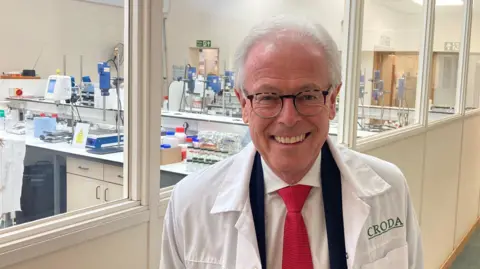
The remarkable story of how a century-old company, Croda International, transformed from its humble origins in Hull, East Yorkshire, into a significant player in Hollywood illustrates the company’s innovative spirit and dedication to advancing healthcare. Founded in 1925 by George Crowe and Henry Dawe in a disused waterworks, Croda initially produced lanolin, a substance derived from sheep’s wool. Over the decades, it flourished, transitioning to various sectors and ultimately cementing itself as a FTSE 100 company. Recently, as it celebrates its centennial, the company reflects on its pivotal role in developing a treatment known as Lorenzo’s oil, related to the rare genetic disorder adrenoleukodystrophy (ALD).
The story of Lorenzo Odone is a poignant one, marked by challenges, determination, and significant achievements. Diagnosed in 1984 with ALD, Lorenzo faced dire predictions about his life expectancy. His parents, Augusto and Michaela Odone, refused to accept this fate, dedicating their lives to researching potential treatments for their son. Their relentless pursuit culminated in a breakthrough — using a concoction derived from olive oil and rapeseed oil, they formulated what would eventually be recognized as Lorenzo’s oil. This pioneering spirit has not only affected their family but also impacted many children worldwide suffering from ALD.
Two streets in Hull, Lorenzo’s Way and Suddaby Close, commemorate their efforts, symbolizing the collective hope and resilience of families touched by rare diseases. The Odones approached Croda based on the company’s established reputation. Don Suddaby, a chemist at Croda, played a crucial role in the research and implementation of this oil, which they hoped would slow the progression of the disease. Mr. Layden, a current director at Croda, recounts how Augusto Odone, despite lacking formal scientific training, presented his hypothesis to Croda. He was fortunate that Keith Coupland, Croda’s technical director, decided to take on the challenge passionately.
The collaboration with the Odones marked a pivotal shift for Croda, allowing it to venture into healthcare, an area it had not previously explored. The groundbreaking culmination of this relationship saw the launch of Lorenzo’s oil, which not only transformed the lives of those afflicted with ALD but also led Croda to expand significantly into the healthcare sector. By the late 1990s, the company established a healthcare division, which has seen substantial growth and innovation, particularly highlighted during the COVID-19 pandemic when Croda contributed significantly to mRNA vaccine development.
The historic headquarters of Croda at Cowick Hall, with its rich heritage and surrounding parkland, serves as a testament to the company’s journey. Sandra Breene, president of consumer care at Croda, expressed concern over the recent closure of the University of Hull’s chemistry department, emphasizing the necessity for educational institutions to nurture the next generation of scientists. This sentiment echoes the pivotal role that education and innovation play in corporate success.
As for Lorenzo Odone, he remarkably lived to age 30, surpassing expectations yet still facing challenges related to his condition. Critiques of Lorenzo’s oil regard its effectiveness as a treatment, suggesting it may not work for those already symptomatic but can help prevent the onset of symptoms in vulnerable individuals. While it may not be a commercially lucrative venture for Croda, this development showcases the company’s commitment to purpose beyond profit and underscores its role in contributing to the well-being of countless families.
In conclusion, Croda International’s evolution from a local manufacturer in Hull to an influential entity in both the healthcare industry and popular culture through the retelling of Lorenzo’s story in a Hollywood film exemplifies the intersection of innovation, determination, and societal impact. As the company continues to advance, its legacy will remain intertwined with the hope sparked by the relentless pursuit of a cure for rare diseases.