


### Record Surge in Gold and Silver Prices: Adapting to Market Changes
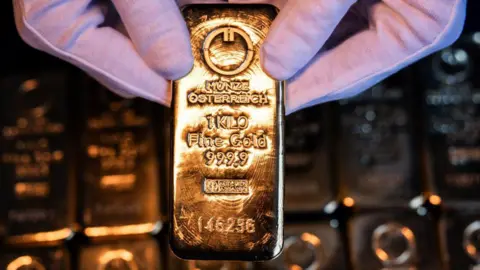
In a remarkable surge, gold prices have achieved a record high, trading above $4,400 (£3,275) an ounce for the first time. This milestone reflects a significant shift in market perceptions as investors seek safe-haven assets amid increasing geopolitical tensions and economic uncertainties. Analysts attribute this rise to the expectation that the U.S. Federal Reserve will lower interest rates in the upcoming year, further driving demand for precious metals like gold and silver.
The year commenced with gold valued at approximately $2,600 per ounce. However, a combination of geopolitical unrest, newly imposed tariffs during the Trump administration, and expectations for rate cuts have spurred growing interest in gold and similar commodities. Notably, the market witnessed a concurrent rise in silver prices, culminating in record highs across various precious metals on this latest trading day.
### Factors Influencing the Gold Market
Gold’s price has escalated over 68% in 2025, the most significant annual increase since 1979. Adrian Ash, the director of research at BullionVault, highlighted “slow-burning trends” surrounding interest rates, conflicts, and trade tensions as key influencers pushing up gold prices. He pointed specifically to the impacts of the Trump administration, suggesting that the trade war and criticisms aimed at the U.S. Federal Reserve have triggered unprecedented interest in gold.
On the most recent trading day, gold peaked at $4,426.66 per ounce. The ongoing expectation of lower interest rates generally translates to reduced returns on investments in bonds, prompting investors to explore commodities, including gold and silver, for better returns and portfolio diversification. Analysts currently forecast two interest rate reductions by the Federal Reserve in 2026.
### Global Central Banks and Demand for Gold
An additional element contributing to the rising prices of gold is the expansion of physical gold holdings by central banks around the globe. This strategy serves as a hedge against economic instability, minimizes reliance on the U.S. dollar, and provides diversification within their portfolios. Reports from Goldman Sachs indicate that this trend is likely to persist through 2026.
The demand for gold is bolstered by perceptions of it as a hedge against inflation and economic volatility. Anita Wright, a chartered financial planner at Ribble Wealth Management, elaborated on the dynamics by stating that when confidence in financial markets wanes, investors turn to gold as the primary monetary metal to safeguard their wealth.
### A Type of Investor Behavior
A depreciating U.S. dollar is also a significant factor in driving up gold prices, making the metal more affordable for international buyers. In conjunction with gold’s trajectory, silver has also seen remarkable growth, achieving a record price of $69.44 per ounce recently. Silver’s performance in 2025, with prices soaring 138% year-to-date, is notable alongside platinum, which has reached its highest value in 17 years. Analysts attribute these rises to robust demand and supply constraints impacting these precious metals.
Unlike gold, silver and platinum have considerable applications in industrial manufacturing, further driving their demand and thereby enhancing their stability in trading.
### Additional Context on Oil Prices
On the same day gold reached new heights, oil prices also increased following the United States’ announcement of a blockade on oil tankers entering and leaving Venezuela. The price of Brent crude moved up by $1.31 to $61.78 per barrel, while U.S. oil rose by $1.25 to $57.77. However, it is worth noting that both oil types appear set to conclude 2025 at lower prices compared to their starting points for the year.
### Conclusion
The recent surge in gold and silver prices underscores a pivot among investors towards commodities perceived as secure amidst economic uncertainties. As traders navigate through complex geopolitical factors and domestic economic policies, gold and silver remain pivotal assets, contributing not only to financial strategies but reflecting broader market sentiments in these turbulent times. Moreover, with expectations pointing toward further interest rate cuts and ongoing global economic challenges, the demand for precious metals looks poised to continue its ascent in the near future.