



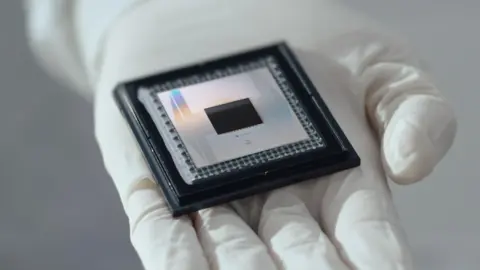
Recently, Google made headlines by announcing its collaboration with leading UK researchers in a substantial effort to expand the applications of its advanced quantum computing technology, known as the Willow chip. This initiative aims to provoke innovative uses for quantum computing, which has emerged as a pivotal frontier in computing technology. Quantum computing, which utilizes the principles of quantum mechanics, is anticipated to revolutionize various sectors by enabling the solving of complex problems that are currently beyond the reach of classical computers.
The Willow chip, released by Google in late 2024, is part of a competitive landscape where major companies, including IBM and Amazon, are working to develop powerful quantum computers. Google’s partnership with the UK’s national lab for quantum computing marks a crucial step in this evolution, potentially accelerating research and application in areas like chemistry and medicine, fields where traditional computing struggles to yield solutions.
Prof. Paul Stevenson from the University of Surrey, while not directly involved in this collaboration, remarked that this partnership is a notable opportunity for UK researchers, allowing them to access Google’s sophisticated technology. He expressed optimism regarding the potential outcomes, noting that researchers will not only benefit but also contribute to the development of practical applications that utilize quantum technology. Furthermore, the collaboration is expected to furnish Google with insights from UK academics who are well-versed in quantum mechanics and its applications.
The collaboration heralds a new era in quantum computing as it opens doors for more researchers to utilize the Willow chip in their studies and experiments. Proposals can be submitted by scientists to detail how they plan to leverage the Willow processor, with guidance from Google and the UK quantum lab. This collaborative model of innovation is not just about technological sharing; it’s about nurturing the next generation of breakthroughs that could significantly impact various scientific and industrial domains.
As quantum computing continues to evolve, experts foresee that the true potential of these advanced machines has yet to be fully harnessed. Current quantum devices are primarily experimental and demonstrate limited practical applications, rendering them tools for addressing a narrow spectrum of problems. By empowering researchers with access to cutting-edge technology, it is expected that new, real-world applications for quantum computation may soon arise, significantly expanding its utility.
Examining the competitive landscape, Dr. Michael Cuthbert, the Director at the National Quantum Computing Centre (NQCC), emphasized that partnerships like the one between Google and UK researchers would “accelerate discovery.” He stated that advancements stemming from this collaboration could eventually lead to new applications in critical fields such as life sciences, material science, and fundamental physics. The NQCC already showcases various quantum computers from local companies, signaling the UK’s growing involvement in this innovative field.
To support this burgeoning sector, the UK government is investing £670 million as part of its Industrial Strategy, focusing on the potential of quantum technology to enhance the economy, which officials estimate could contribute approximately £11 billion by 2045. This investment is particularly pivotal given the rising significance of quantum computing in the global digital economy.
With remarkable advances and intensifying competition from prominent firms increasingly entering this space, experts predict that more powerful quantum machines will emerge within the next decade. The UK is already home to a burgeoning quantum industry, exemplified by Quantinuum—a company with valuations soaring to $10 billion—underscoring the serious investment and interest surrounding quantum technologies.
As research collaborations between tech giants and academic institutions expand, the journey towards fully realizing the possibilities of quantum computing is poised to gather pace, driven by collective innovation and shared expertise. By unlocking the potential of its quantum chip, Google is not only enhancing its technological edge but also contributing to a collaborative ecosystem that might very well define the future of computing.