
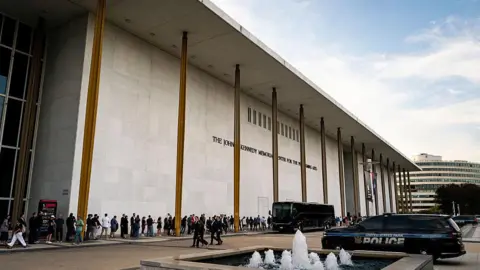
In a surprising move announced by the White House, the iconic John F. Kennedy Center for the Performing Arts is set to undergo a significant rebranding to become the Trump-Kennedy Center. This decision follows a board vote that reportedly took place with unanimous approval, as conveyed by White House Press Secretary Karoline Leavitt. She touted the board’s decision as a recognition of the “unbelievable work” undertaken by President Donald Trump to revitalize the landmark building since his return to power in January 2025.
The Kennedy Center, a revered establishment in Washington, D.C., has long been a symbol of cultural enrichment and is named after President John F. Kennedy, who was assassinated in 1963. The announcement of the renaming has sparked a wave of controversy across the political spectrum, especially among those who view it as an unfortunate politicization of a cultural institution. Critics argue that the making of such changes reflects the ongoing trend of merging political agendas with the arts, something many believe should remain independent.
Leavitt expressed her excitement for the rebranding, indicating that it would lead to a successful and prosperous future for the center. In her remarks on social media, she congratulated Kennedy for his legacy, stating that the merger would create a “truly great team long into the future.” However, this optimistic outlook is set against a backdrop of skepticism, especially given the Kennedy Center’s historical significance and its established name recognition.
President Trump, upon hearing the news of the board’s decision, stated he was both “surprised” and “honored.” His administration has laid out plans to address the physical state of the Kennedy Center, with Trump declaring that “we saved it” after securing approximately $257 million in federal funding aimed at major renovations and preservation efforts. Despite these claims, critics have voiced concerns regarding the board’s composition, noting that many members have been appointed because of their close ties to the administration.
Among the figures on the board include notable figures such as Attorney General Pam Bondi, White House Chief of Staff Susie Wiles, and Second Lady Usha Vance. Their proximity to the current administration raises questions about the decision-making process behind the name change. Adding to the tension, Representative Joyce Beatty, a Democratic board member, has contested the characterization of the board’s vote as unanimous, alleging that she was not permitted to voice her opposition during the deliberations.
Legally, the name change may encounter hurdles, as any modification to the Kennedy Center’s name is bound by a law enacted in 1964, which originally designated its nomenclature in honor of JFK. As a result, a congressional vote would be necessary to formalize this significant transition—a fact not lost on lawmakers and legal scholars. Previously introduced measures that sought to rename another venue within the center to honor First Lady Melania Trump have lagged, indicating a complex legislative landscape surrounding the naming conventions.
Despite the hurdles, there are paths for the center to proceed with the name change informally, including on digital platforms and promotional materials. However, it remains unclear how this rebranding will impact public perception or ticket sales moving forward. The Kennedy Center has already witnessed a downturn in performance attendance, a potential consequence of the politicization of cultural institutions under the current administration.
Trump himself has publicly stated his involvement in several aspects of the Kennedy Center’s programming, including this year’s honorees, which included figures like Sylvester Stallone and members of the rock band KISS while notably disparaging proposed candidates deemed “woke.” This level of engagement raises further questions about the administration’s influence on the arts.
Ultimately, the renaming of the Kennedy Center presents a complex intersection of culture, politics, and public sentiment, indicating a future where artistic spaces could become arenas for political and ideological battles. As the discussion surrounding the center evolves, it remains to be seen how these changes will reshape the cultural landscape in Washington, D.C., and the broader national narrative.