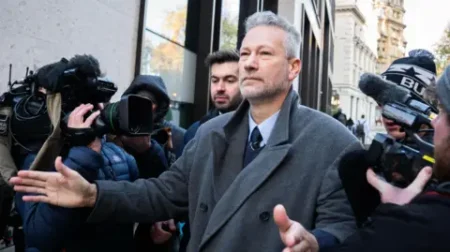




In a surprising move, Lord Peter Mandelson, the incoming United Kingdom ambassador to the United States, has lauded President-elect Donald Trump, describing his forthcoming presidency as potentially “one of the most consequential” in modern history. This statement, which Mandelson articulated in an article published for Fox News, contrasts sharply with the critical stance he took previously. Notably, in 2019, he labeled Trump a “danger to the world” and added that he was “little short of a white nationalist”. Mandelson’s remarks signal a significant shift in his perspective, revealing the complexities and often volatile nature of political alliances.
As a prominent figure from the Labour Party, Mandelson served in key positions during the administrations of both Tony Blair and Gordon Brown. His commitment to serve as the UK’s envoy in Washington, D.C. is set for early 2025, shortly after Trump’s expected inauguration into the White House. Mandelson’s unexpected camaraderie with Trump follows a tumultuous relationship marked by sharp criticisms. Trump’s campaign advisor had previously dismissed Mandelson as an “absolute moron”, underscoring the heated exchanges that can characterize political discourse.
Delving into Mandelson’s article, he emphasizes the necessity for Britain to evolve its “Atlantic alliance” to meet new global challenges. He asserts that the historical advantages of this partnership cannot shield it from emerging threats that technology and geopolitical shifts inherently pose. He stresses that American allies must receive and interpret the message conveyed by the American electorate during the elections, suggesting a recalibration of international partnerships with a mindset geared towards cooperative problem-solving.
A central theme of Lord Mandelson’s piece is the notion that Trump’s navigational skills in political campaigning resonate with segments of the population who, for various reasons, feel marginalized and unheard. He interprets Trump’s electoral triumph as a crucial opportunity for allies to embrace innovative thinking—signaling a potential shift toward solutions focused on real-world applications in foreign policy. Mandelson notably remarks that the Trump administration’s primary concern will be to prioritize the American populace’s needs, yet he believes that it must also acknowledge and work with its historical allies.
Mandelson’s anticipations for the Trump presidency come with a recognition of the necessity for both the UK and other allies to remain adaptable and proactive. He urges for a collaborative approach that seeks mutual benefit, thereby enriching opportunities for citizens of both the U.S. and the UK. As he prepares to take over from Dame Karen Pierce, whose tenure aligns with the transition to Trump’s leadership, Mandelson is positioning himself strategically to facilitate a positive discourse between the UK and U.S. during what could be a pivotal moment in international relations.
The article further reflects Mandelson’s alignment with prevailing U.S. critiques of China and Iran. He expresses unequivocal condemnation toward the current Chinese regime, characterizing it as “more aggressive abroad and controlling at home,” claiming its actions directly challenge Western values and governance. Additionally, he speaks of Iran as a “thoroughly malign force” within the Middle East context, asserting that the international community must never relent in efforts to prevent it from acquiring nuclear capabilities.
In sum, Lord Mandelson’s recent comments regarding Donald Trump are emblematic of the intricacies that define political dynamics, showcasing the importance of diplomatic relations while navigating contentious political landscapes. As he embarks on his new role in Washington, his insights provide a glimpse into the expectations and approaches that will shape the U.K.’s foreign policy amidst evolving global challenges.