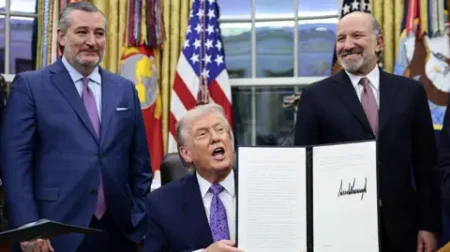



In a surprising move that has caught the attention of both political and tech spheres, Meta, the parent company of Facebook, Instagram, and WhatsApp, has made a significant $1 million donation to the inauguration fund of Donald Trump. This donation highlights a strategic attempt by Mark Zuckerberg, the founder of Meta, to foster a more amicable relationship with the incoming president. Having been previously criticized by Trump, who labeled Facebook as “anti-Trump” in 2017, this financial gesture marks a notable shift in their dynamic.
Interestingly, this collaboration emerges from a backdrop of animosity. Trump and Zuckerberg’s relationship soured dramatically, particularly following the suspension of Trump’s accounts on Facebook and Instagram in 2021. This suspension came in the wake of the events at the U.S. Capitol on January 6, where Trump was accused of inciting violence. Following these events, Trump continued to express disdain for Meta, branding Facebook as an “enemy of the people” and accusing it of unfairly benefiting from political developments such as the proposed ban on TikTok, owned by ByteDance.
Despite the historical tension, a recent dinner between Zuckerberg and Trump at the latter’s Mar-a-Lago resort appears to have set the stage for this new beginning. Zuckerberg referred to the meeting as a moment he was “grateful” for, indicating a possible thaw in their previously frosty interactions. It’s essential to note that inauguration funds serve to underwrite the events and activities associated with inaugurating a new president. This type of donation is sometimes viewed as a strategy to gain favor with the new administration, a move that Meta did not engage in during Joe Biden’s inauguration in 2020 or Trump’s previous inaugural fund in 2016.
The news of Meta’s donation was confirmed by CBS, a partner of the BBC in the United States, and it was first reported by the Wall Street Journal. As Trump prepares for his inauguration on January 20 as the 47th President of the United States, this act could signify a broader strategy by tech firms looking to align themselves with the new political landscape.
Looking into the history between Zuckerberg and Trump, it is clear that their relationship has been tumultuous. Since the suspension of Trump’s accounts, he has condemned Meta’s actions repeatedly. Moreover, Trump’s published views have ranged from violent threats towards Zuckerberg to more conciliatory notes. He recently acknowledged Zuckerberg’s decision to “stay out of the election,” even expressing thanks for a personal phone call after Trump faced a serious assassination attempt.
While Zuckerberg’s approach appears more conciliatory compared to the relationship Trump maintains with other business moguls like Elon Musk—who has been dubbed “Trump’s First Buddy” due to his substantial donations to Trump’s campaign—the nature of their interactions remains markedly different. Musk has garnered influence within Trump’s circle, even receiving an appointment to the newly established Department of Government Efficiency (Doge).
It is also worth noting that although Zuckerberg’s donation might signal a more favorable position towards Trump, the intricacies of their relationship remain complicated and fraught with the potential for conflict. Despite recent gestures of goodwill, the historical context casts a long shadow, highlighting the ambiguity in their future interactions.
In summary, Meta’s substantial donation to Trump’s inauguration fund is not merely a financial transaction; it represents an attempt at reconciliation after years of hostilities. However, this gesture does not erase the past, nor does it guarantee that future relations will be devoid of conflict. As Zuckerberg navigates this complex landscape, the coming months will reveal whether this tentative bridge-building can endure the trials and tribulations of the political arena.