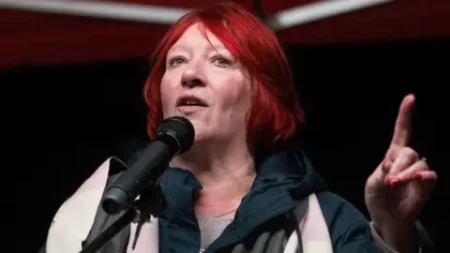



The political landscape in Canada has recently experienced significant upheaval following the unexpected resignation of Finance Minister Chrystia Freeland. This drastic turn of events has crucial implications for Prime Minister Justin Trudeau’s administration, casting the government’s stability into doubt. Freeland’s sudden exit has ignited fierce debates within the Liberal Party, with increasing pressure on Trudeau to consider his position as party leader and potentially step down from his role as prime minister.
By the end of a tumultuous Monday, Trudeau appointed a new finance minister to replace Freeland, but the air was thick with dissent within his party. Trudeau acknowledged the challenging day indirectly at a donor event in Ottawa, expressing, “It’s obviously been an eventful day. It has not been an easy day.” Freeland’s resignation came just before she was expected to deliver a pivotal economic statement, and her critical letter underscored deep-seated disagreements with Trudeau over how to navigate the looming threat of tariffs from incoming U.S. President Donald Trump.
Trump, planning to return to the White House in January, has threatened to impose a 25% tariff on Canadian imports if security measures along the U.S.-Canada border are not reinforced. Economists have warned that such tariffs could severely impact the Canadian economy. Freeland, in her resignation letter, accused Trudeau of favoring “costly political gimmicks” rather than confronting Trump’s “aggressive economic nationalism.” Trump’s own remarks on social media labeled Freeland’s demeanor as “toxic,” exacerbating the tension between the two nations.
Freeland’s abrupt departure left the Canadian government in disarray, delaying the anticipated economic update and sending shockwaves through Trudeau’s already fragile minority government. Compounding matters, the Liberal Party also suffered a significant setback, losing the Cloverdale-Langley City riding in British Columbia to the Conservative Party, marking the third by-election loss for the Liberals this year.
Experts have weighed in on the ramifications of Freeland’s resignation. Chris Sands, director of the Wilson Center’s Canada Institute, described the situation as one that reflects confusion and uncertainty for Canada. He noted that Trudeau appears isolated, lacking close allies among his remaining ministers. The political turmoil has been exacerbated by the divided responses among U.S. allies, including Canada, on whether to confront Trump or seek accommodation.
Freeland, serving not only as finance minister but also as deputy prime minister, was a key figure during the first Trump administration, playing a vital role in renegotiating the North American Free Trade Agreement. Her experience had aligned more closely with the Mexican response to Trump’s tariffs, suggesting a strategy of resistance rather than submission. Many politicians reflect on the challenging environment they faced during Trump’s earlier tenure, signaling a readiness to adapt swiftly even before he assumes office once more.
In light of this crisis, opposition leaders are seizing the moment to call for Trudeau’s resignation. Pierre Poilievre, the leader of the Conservative Party of Canada, has emphatically stated the need for a federal election, asserting that the situation under Trudeau’s leadership is spiraling out of control.
With Canada’s federal election slated for October at the latest, some political analysts question whether a new leader would genuinely alter the dynamics in relations with the U.S. Laura Stephenson, chair of the political science department at Western University, expressed skepticism about any potential shift in Trump’s attitudes towards a new Conservative leadership compared to Trudeau’s.
For Trudeau, the pressure has intensified as his approval ratings have plummeted from 63% at the beginning of his tenure to approximately 28%. This decline in popularity, coupled with calls from at least eight Liberal MPs for him to resign, signifies the internal unrest within his party. Trudeau has indicated he will reflect on the day’s events, yet has firmly stated his intention to remain in leadership and run in the next election.
As the political landscape evolves, leaders of Canada’s provinces met to address the looming tariff threat, with Ontario Premier Doug Ford describing the current atmosphere in Ottawa as chaotic. He emphasized a need for assurance regarding stability and certainty in Canada amidst the ongoing turbulence in Trudeau’s government. This complex interplay of factors suggests that the upcoming months will be crucial for both Trudeau and the broader Canadian political landscape as they navigate these tumultuous waters.